
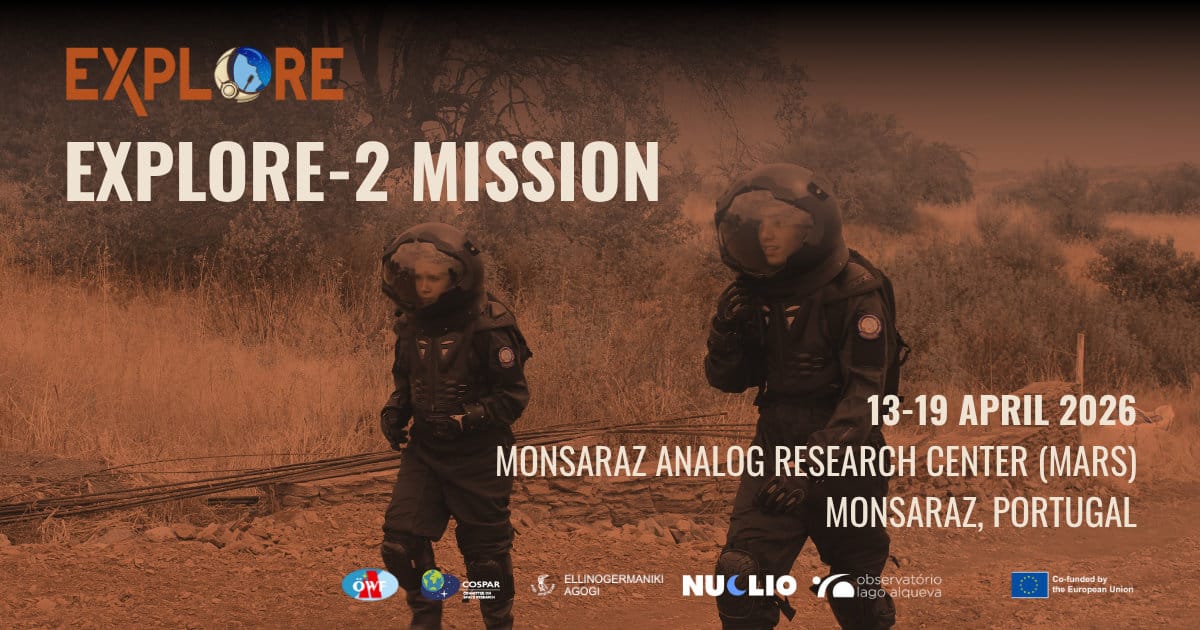
Between 13 and 19 April 2026, the Monsaraz Analog Research Station—MARS, located at the Alqueva Lake Observatory, will once again host a distinctive educational and scientific experience. Nine secondary school students, three from each partner country in the European EXPLORE project, Austria, Greece and Portugal, will take part in the EXPLORE-2 mission, a Mars mission simulation.
Over the course of a week, these young participants, aged between 16 and 18, will live and work in a habitat specially designed for the mission. They will collaborate as a team, operate rovers and conduct scientific experiments, much like in real space missions, within an environment that recreates the demanding conditions of the Red Planet.
This initiative builds on the success of the EXPLORE-1 mission, held at the same location in June 2025, which received widespread media coverage not only in Portugal but across several European countries. It also incorporates operational procedures from the AMADEE programme of the Austrian Space Forum.
Portugal’s presence in the EXPLORE-2 mission will be represented by students from three different schools: Agrupamento de Escolas Professor Agostinho da Silva, in Sintra; Escola Secundária de Paredes, in Paredes; and Agrupamento de Escolas Frei Gonçalo de Azevedo, in Cascais. The group is further complemented by six students from schools in Austria and Greece.
The EXPLORE missions are part of the EXpeditionary Program for Learning OppoRtunities in analog space Exploration(EXPLORE), funded by the European Union through the Erasmus+ programme. The project partners include the Austrian Space Forum, NUCLIO, the Greek school Ellinogermaniki Agogi (EA), the Committee on Space Research (COSPAR), and the Alqueva Lake Observatory.
About Analogue Space Missions
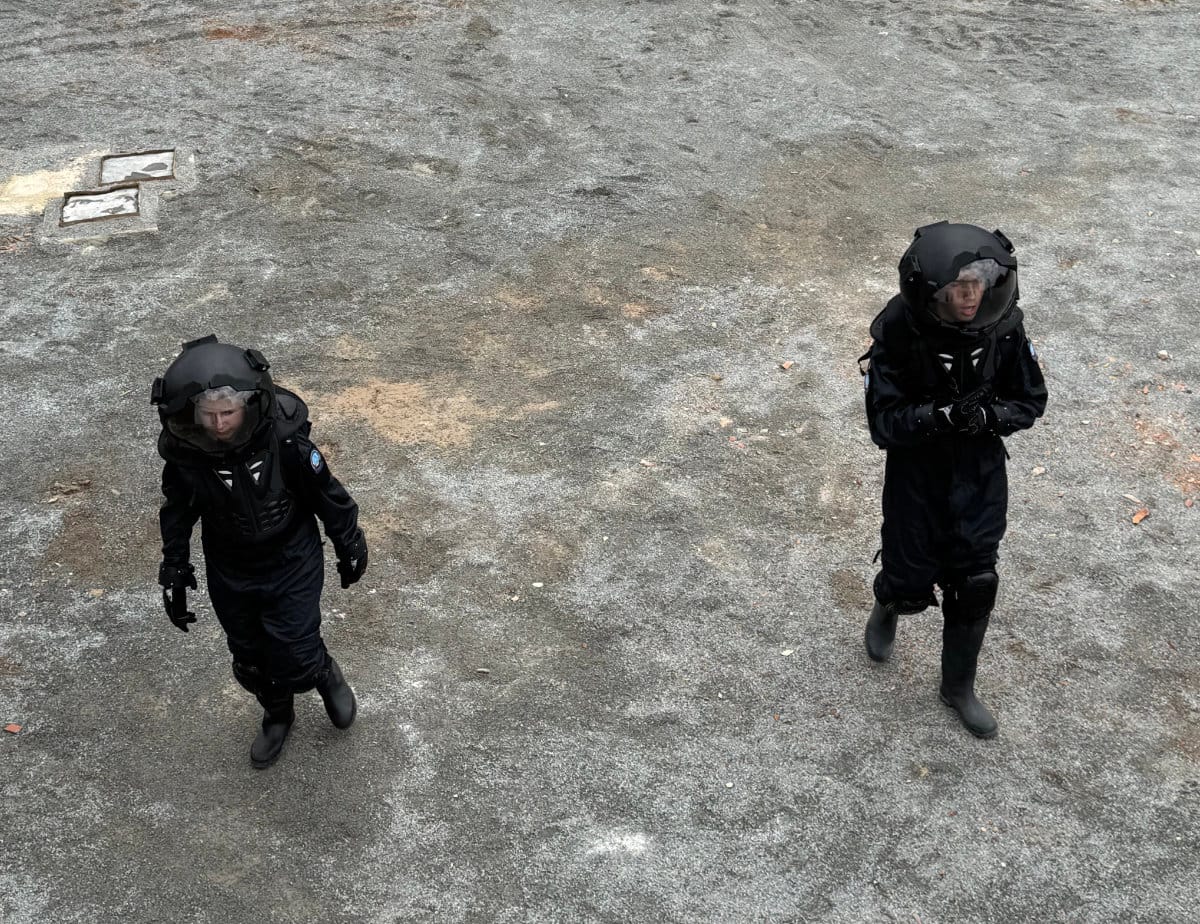
Analogue space missions are ground-based simulations designed to replicate the extreme conditions of other planetary bodies, such as Mars or the Moon. They play a vital role in testing equipment and procedures, as well as studying the psychological and physiological effects of isolation on crews before real space missions take place. The area surrounding the Alqueva Lake Observatory, near Monsaraz, offers an barren, reddish landscape closely resembling Mars, making it particularly suitable for this type of training. Whenever they leave the habitat to carry out scientific experiments, such as collecting rock samples, the students will wear Delta suits, similar to those used by astronauts.
Hands-on Experience in Space Science
“We believe the future of space exploration lies in inspiring today’s students. EXPLORE-2 represents our continued commitment to giving young people authentic, hands-on experience in space science. These students aren’t just learning about space—they’re living it,” says Rosa Doran, Director of NUCLIO.
Did You Know?
- All students taking part in EXPLORE-2 were selected by their their classmates and Space Coach teachers.
- The students, coming from different schools, have not met each other before—trust, team-work and cooperation will have to be established early to ensure mission success.
- Any school can take part in the EXPLORE project, regardless of its location, by using the EXPLORE virtual toolkit.
End-of-Mission Press Conference
On Sunday, 19 April, between 12:00 and 13:00 local time, the mission’s closing press conference will take place at the Alqueva Lake Observatory in Monsaraz.
This will be a particularly special moment, as the students will leave the mission habitat, allowing journalists to closely follow the conclusion of this experience. There will be opportunities to capture images, interact with the team and take part in hands-on activities inspired by the life of an astronaut.
- For press accreditation or to schedule interviews, please send an email to leigh.fergus@cosparhq.cnes.fr by 17 April 2026.
Members of the media may ask questions either in person or remotely. A Zoom link will be provided for journalists who choose to participate online.
There will also be opportunities to interview the students, their accompanying teachers and project leaders via video conference remotely during the mission, to get direct feedback on their experience as it happens. Interview requests should be sent to the same address.
For further details, please refer to COSPAR Press Release.